How chatbots elevate home service businesses: efficiency & engagement
How chatbots elevate home service businesses: efficiency & engagement ! Business owner using chatbot system in home kitchen Most home service business owners assume chatbots make customer interactions feel cold and robotic.

Most home service business owners assume chatbots make customer interactions feel cold and robotic. That assumption is costing them real money. The truth is, a well-deployed chatbot doesn't push customers away. It frees your team to have better, more profitable conversations. This guide breaks down exactly how chatbots work in home services, what the data actually shows, and the practical steps you can take right now to start seeing results without falling for overhyped promises.
Key Takeaways
| Point | Details |
|---|---|
| Chatbots boost efficiency | They automate routine tasks so your team can focus on higher-value work. |
| Staff are empowered, not replaced | AI allows employees to upskill and deliver better customer service and sales. |
| Customer experience improves | Instant response and consistent information elevate client satisfaction. |
| Incremental adoption wins | Success comes from adding chatbots step by step, not by rushing total automation. |
Understanding chatbots: Beyond the hype
A chatbot is an automated digital assistant that communicates with customers through text or voice. It can answer questions, book appointments, collect lead information, and route requests to the right person. Simple as that.
But the myths around chatbots are loud. Here are the most common ones you should stop believing:
- Chatbots replace your staff. They don't. They handle the repetitive stuff so your team can focus on higher-value work.
- Chatbots feel impersonal. A well-configured chatbot mirrors your brand voice and guides customers smoothly.
- Chatbots are just spam machines. Real chatbots respond to customer-initiated conversations with relevant, helpful answers.
- Chatbots are too complex for small businesses. Modern platforms are built for non-technical users.
The smarter way to think about chatbots is as a first-response layer. They catch every inquiry, qualify it, and either resolve it or pass it to a human. That's not replacing your team. That's making your team more effective.
AI augments, not replaces your workforce. The real opportunity in 2026 is reskilling staff to handle complex situations and upsell conversations, while chatbots manage the routine load. Foundational work now sets you up for long-term gains.
Pro Tip: Before you build a chatbot, list the five questions your front desk answers most often. Those five answers become your chatbot's first five responses. Start there.
Streamlining operations with intelligent automation
With a fresh perspective on chatbots' role, let's examine exactly how they make operations smoother in your daily business.
Here's where chatbots deliver the most immediate value for home service companies:
- Automated appointment scheduling — Customers book, reschedule, or confirm without calling in.
- Instant FAQ responses — Service area, pricing ranges, and availability answered in seconds.
- Quote request collection — Chatbots gather job details before a tech ever picks up the phone.
- Service status updates — Customers get real-time updates without tying up your dispatcher.
The real power comes from integration. When your chatbot connects directly to platforms like ServiceTitan or Jobber, every booking and inquiry flows into your existing workflow automatically. No double entry. No dropped leads.
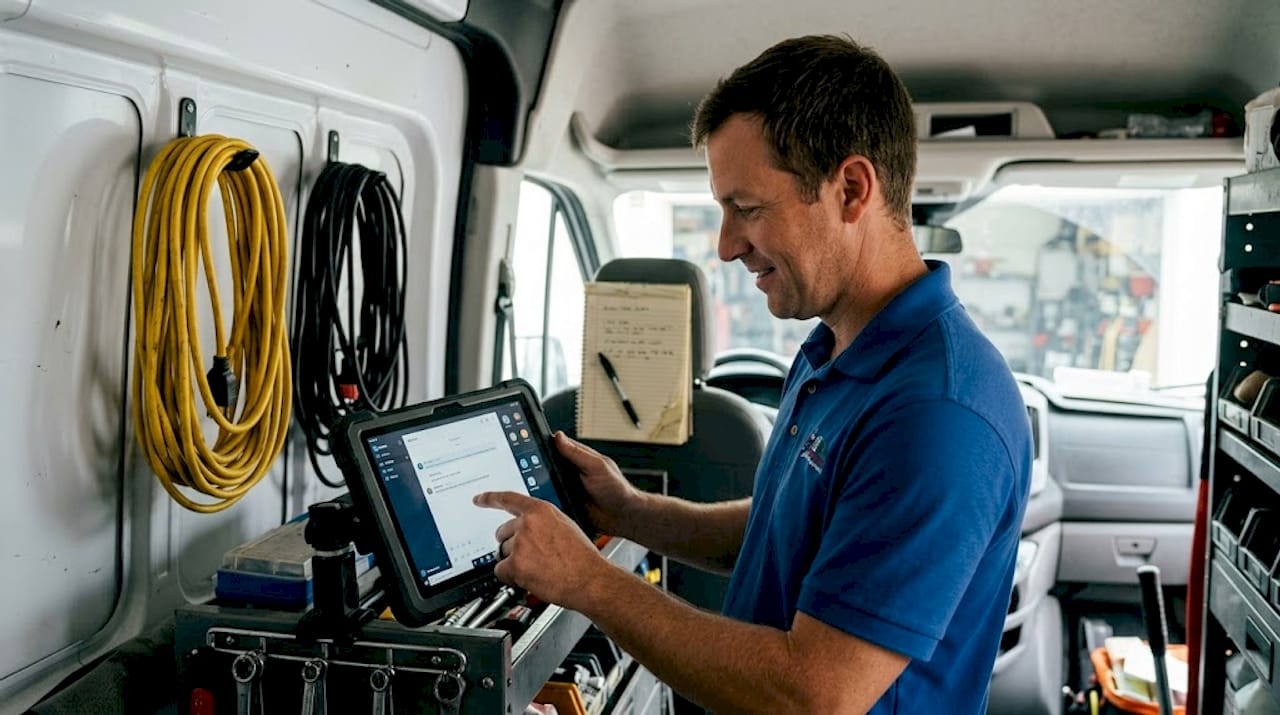
The numbers back this up. Self-service and live chat are projected to surpass traditional service channels by 2027, driven by chatbot adoption across service industries.
| Workflow area | Without chatbot | With chatbot |
|---|---|---|
| Missed call rate | High, especially after hours | Reduced by up to 85% in HVAC |
| Response time | Minutes to hours | Under 30 seconds |
| Lead capture rate | Dependent on staff availability | 24/7 automated capture |
| Dispatcher workload | High volume of routine calls | Focused on complex dispatching |
Pro Tip: If you run an HVAC, plumbing, or electrical business, after-hours chatbot coverage alone can recover leads you're currently losing every single night.
Enhancing customer experience and driving revenue
Beyond streamlined back-end processes, chatbots deeply influence how customers interact with your business, often in ways business owners don't expect.
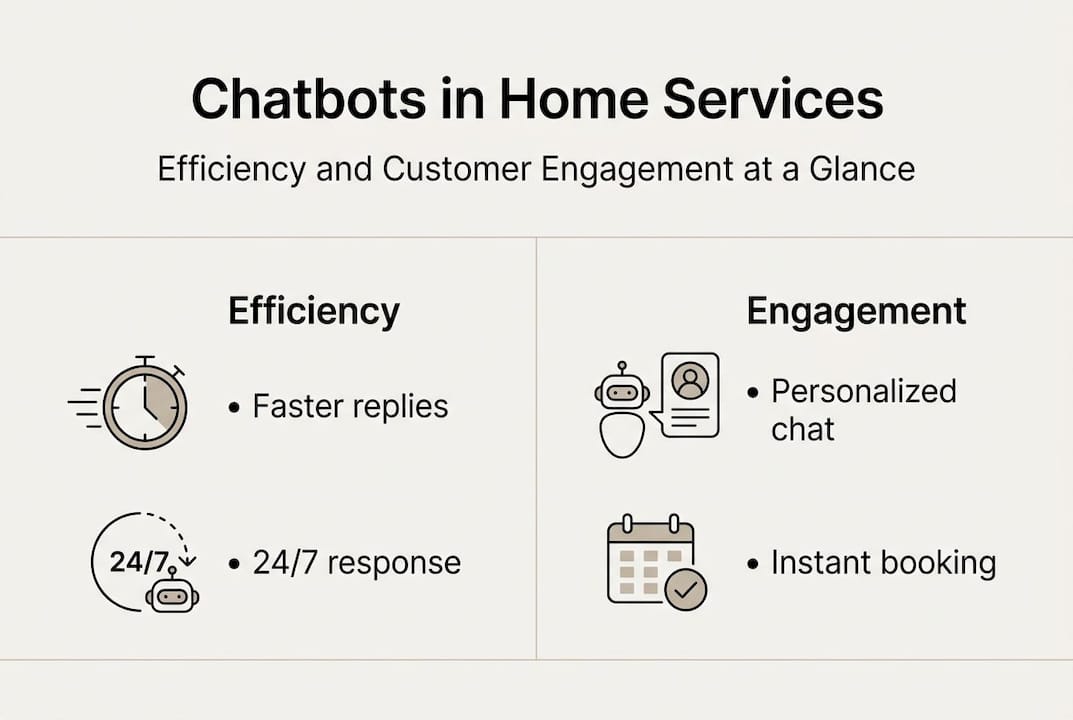
Customers today expect fast answers. Not next-day callbacks. Not hold music. A chatbot gives them an immediate response at 11pm on a Sunday, which is exactly when a homeowner notices their furnace isn't working.
Here's how the customer experience shifts when chatbots are in play:
- Consistent information — Every customer gets the same accurate answer, every time.
- Faster resolution — Routine questions are answered instantly, reducing frustration.
- Smooth escalation — When a situation needs a human, the chatbot hands off the full conversation context so the customer doesn't repeat themselves.
- Upsell opportunities — With routine tasks automated, your staff focuses on closing bigger jobs and recommending add-on services.
| Experience factor | Traditional service | Chatbot-augmented service |
|---|---|---|
| Availability | Business hours only | 24/7 |
| Response speed | 2 to 8 hours average | Under 1 minute |
| Staff focus | Mixed routine and complex | Complex and revenue-generating |
| Customer satisfaction | Variable | More consistent |
"The fastest path to revenue growth isn't more ads. It's making sure every customer inquiry actually gets answered."
The IKEA example is hard to ignore. IKEA reskilled 8,500 agents and generated €1.3 billion in revenue by using chatbots to handle routine service while redirecting staff toward higher-value customer interactions. That same logic applies directly to your home service business.
Getting started: Practical steps for home service businesses
You've seen the benefits, but what does it really take to put chatbots to work for your company?
Here's a simple framework to get moving without overcomplicating it:
- Audit your repetitive customer touchpoints. Write down every question your team answers more than three times a week. Scheduling, service areas, pricing, job status. These are your automation targets.
- Choose a platform that integrates with your CRM. Whether you use Jobber, ServiceTitan, or another tool, your chatbot needs to plug in directly. Disconnected tools create more work, not less.
- Launch a focused pilot. Pick one or two use cases, appointment booking and FAQ responses work well, and run the chatbot for 30 days.
- Measure what matters. Track missed call rate, response time, and lead capture volume. These numbers tell you exactly what the chatbot is doing for your bottom line.
- Reskill your team in parallel. As the chatbot absorbs routine work, train your staff for upselling, complex problem-solving, and relationship-building.
For context on how AI and security technology is reshaping service-based industries, the pattern is consistent. Automation handles the predictable. People handle the nuanced.
Foundational chatbot adoption in 2026 means starting smart and building from results, not chasing a full transformation overnight. Sensible rollouts outperform rushed ones every time.
Pro Tip: Set a 90-day review point after your pilot. If your missed call rate dropped and your team is spending more time on revenue-generating work, you have your proof of concept.
Our perspective: Slow and steady beats hype in 2026
We've worked with enough home service businesses to say this plainly: the biggest chatbot failures come from expecting too much, too fast.
Vendors will promise overnight transformation. Don't buy it. The businesses seeing real gains are the ones treating chatbot deployment as a process, not a product launch. They start small, measure honestly, and build from what works.
AI augments, not replaces your team. That's not a disclaimer. That's the actual strategy. When you free your staff from answering the same five questions all day, they become better at the work that actually grows your business. In 2026, the home service businesses that win are the ones building smart operations now, not the ones chasing the loudest trend.
Ready to enhance your business with AI chatbots?
If this article gave you clarity but you're still not sure where to start, that's completely normal. Chatbot strategy looks different for every business, and getting it right the first time saves you time and money. Working with an AI strategist for home services means you get a deployment plan built around your actual workflows, your CRM, and your customer patterns. No generic templates. No wasted budget. Just a practical path to better operations and more revenue from the leads you're already getting.
Frequently asked questions
How can chatbots help reduce missed customer calls in home services?
Chatbots answer routine inquiries instantly and handle bookings around the clock, which has led to up to 85% fewer missed calls for some HVAC businesses.
Do chatbots replace traditional staff roles in home services?
No. Chatbots handle routine questions while experienced staff are reskilled for complex cases and sales conversations, which increases overall team value.
What's a proven business impact of chatbots for home service companies?
IKEA's chatbot-driven approach reskilled 8,500 agents and added €1.3 billion in revenue by empowering staff to focus on higher-value customer service.
What's the first step to adopting chatbots for my home service business?
Start by listing your most repeated customer questions, then select a chatbot platform that integrates with your existing tools. Prioritize foundational implementation over all-in transformation for the best results.