Conversational AI guide for home service businesses
Conversational AI guide for home service businesses ! Technician coordinating home service schedule The global conversational AI market is projected to reach $17 to $23 billion in 2026, yet most home service business owners still think this technology means a basic chatbot on a website.

The global conversational AI market is projected to reach $17 to $23 billion in 2026, yet most home service business owners still think this technology means a basic chatbot on a website. It's a natural assumption, but it misses the bigger picture. Conversational AI is a layered suite of technologies that can genuinely change how you schedule jobs, qualify leads, and serve customers around the clock. This article breaks down how it works, where it falls short, and where it can actually move the needle for your business.
Key Takeaways
| Point | Details |
|---|---|
| Beyond simple chatbots | Conversational AI leverages advanced language processing to simulate real conversations and context. |
| Practical business benefits | Home service businesses can automate responses, scheduling, and lead qualification to boost efficiency. |
| Know the limitations | Accuracy drops in long chats and with slang or noise, so set clear boundaries for your AI tools. |
| Adopt strategically | The AI market is evolving quickly—focus on business needs and measurable outcomes, not trends. |
What is conversational AI? Core concepts explained
Conversational AI is not a single tool. It's a system of technologies working together to simulate real human conversation. Where traditional chatbots follow rigid scripts and break the moment a customer says something unexpected, conversational AI adapts.
At its core, conversational AI fundamentals include five key components:
- Natural Language Processing (NLP): Helps the system read and interpret human language in context.
- Natural Language Understanding (NLU): Extracts the actual intent behind what a customer says.
- Natural Language Generation (NLG): Builds a response that sounds human, not robotic.
- Machine Learning (ML): Allows the system to improve every time it handles a new conversation.
- Dialogue Management: Keeps the conversation on track across multiple turns.
These components work together so the system can handle your customer asking "Can someone come fix my AC Thursday morning?" and actually book that appointment rather than returning a menu of options.
| Feature | Traditional chatbot | Conversational AI |
|---|---|---|
| Response style | Scripted, rigid | Dynamic, context-aware |
| Handles unexpected input | Often fails | Adapts and recovers |
| Learns over time | No | Yes, via ML |
| Understands intent | Limited | Yes, via NLU |
| Best for | Simple FAQs | Complex customer journeys |
The difference matters because home service customers rarely ask textbook questions. They ramble, they change their minds mid-sentence, and they use slang. A scripted bot frustrates them. A true AI system keeps up.
Pro Tip: If a vendor calls their tool "conversational AI" but it only follows decision trees, it's a standard chatbot with better marketing. Ask specifically whether the system uses NLU and ML.
How conversational AI works: Step-by-step process
Knowing the components is one thing. Seeing how they connect in a real customer interaction makes it practical. The mechanics of conversational AI follow a clear sequence from the moment a customer types or speaks to when they receive a reply.
- Input capture: The customer sends a message or speaks into a voice interface. Audio is converted to text via Automatic Speech Recognition (ASR).
- Intent extraction: NLU reads the text and identifies what the customer actually wants, such as booking a service, checking a status, or asking about pricing.
- Context tracking: The system remembers what was said earlier in the conversation so it can give relevant replies instead of starting over each turn.
- Knowledge retrieval: The system pulls from your business data, your calendar, your service list, or your FAQ database to build an accurate answer.
- Response generation: NLG turns that data into a natural sentence your customer can read or hear.
- Continuous learning: ML logs the interaction and updates the model so future conversations go more smoothly.
| Step | Business benefit |
|---|---|
| Intent extraction | Fewer missed opportunities from misunderstood requests |
| Context tracking | Customers don't repeat themselves |
| Knowledge retrieval | Accurate, real-time answers on availability and pricing |
| Continuous learning | Performance improves without manual updates |
For a roofing company, this could mean a customer asking about storm damage estimates at 10 PM gets an accurate answer and a booked inspection slot, all without a staff member picking up the phone.

Pro Tip: When you set up a conversational AI for your business, define clear boundaries for what it should and should not handle. Route complex complaints or pricing negotiations to a human. That handoff builds trust instead of breaking it.
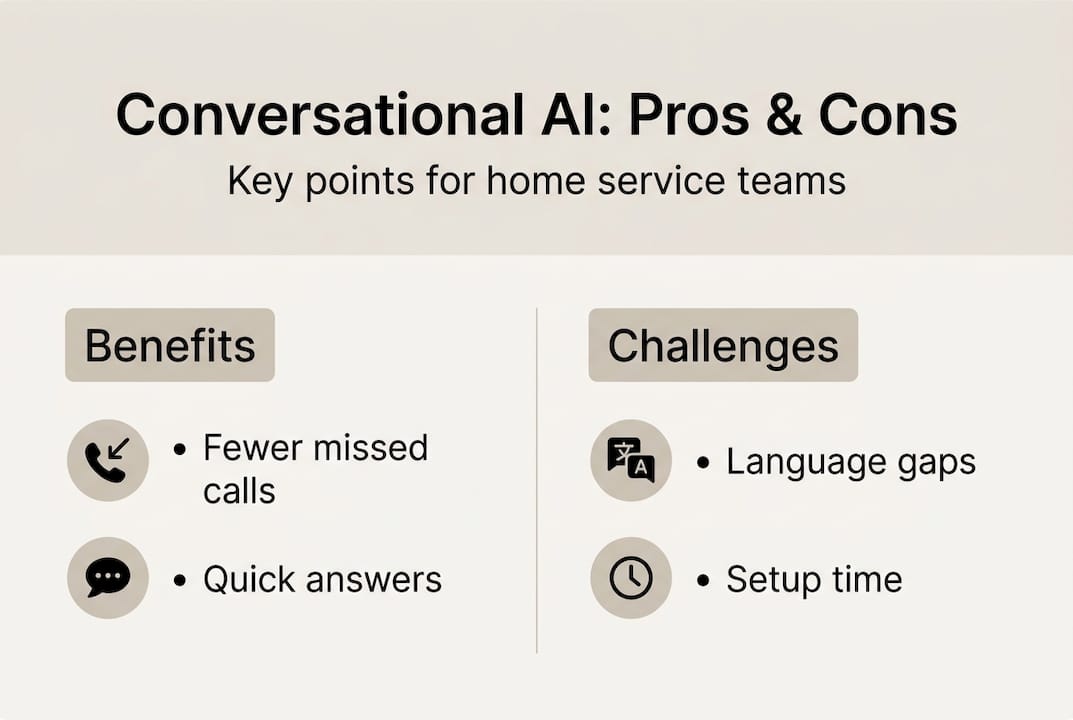
Challenges and limitations of conversational AI
Conversational AI is powerful, but it is not perfect. Before you commit budget and time, you need to understand where these systems struggle.
"AI accuracy challenges compound in longer conversations, with accuracy dropping significantly as context builds up over extended exchanges. Edge cases involving slang, jargon, dialects, background noise, and multilingual input remain persistent weak points."
For home service businesses, this shows up in practical ways:
- A customer with a strong regional accent may get misheard by the ASR layer, leading to wrong bookings.
- Trades-specific jargon like "GPO" or "P-trap" can confuse a general AI that hasn't been trained on your industry.
- Background noise on a job site call can degrade voice input quality.
- Long conversations where a customer changes details multiple times can cause the AI to lose track of what was agreed.
- Hallucinations, where the AI confidently gives a wrong answer, are a real risk if the knowledge base is incomplete.
Mitigation strategies to reduce these risks:
- Train your AI on industry-specific vocabulary before launching.
- Set confidence thresholds so the AI escalates to a human when it's uncertain.
- Review conversation logs weekly to catch recurring errors early.
- Keep your knowledge base updated when services, pricing, or availability changes.
None of these limitations make conversational AI a bad investment. They make it a tool that requires thoughtful setup, not a plug-and-play shortcut.
Conversational AI for home service businesses: Real-world applications
With a clear picture of how the technology works and where it stumbles, here's where it genuinely delivers for home service companies. Customer support and AI adoption are the primary drivers behind market growth, and home services is one of the verticals feeling that shift most directly.
Practical use cases for your business include:
- 24/7 appointment scheduling: Customers book HVAC tune-ups or plumbing inspections at midnight without waiting for office hours.
- Lead qualification: The AI asks the right questions to determine service area, job scope, and budget before your team spends time on a call.
- FAQ automation: Common questions about pricing tiers, service guarantees, or response times get answered instantly and consistently.
- Follow-up reminders: Post-service check-in messages are sent automatically, improving reviews and repeat business.
- Seasonal promotion delivery: Customers who asked about AC service in spring get targeted outreach before summer peaks.
- Upsell prompts: When a customer books a basic service, the AI can mention a relevant add-on based on the job type.
The operational payoff is real. Your team spends less time answering the same questions and more time on the work that actually generates revenue. Customers get faster, more consistent responses. And you capture leads that would have gone to a competitor who answered first.
Why AI adoption should be strategic, not just trendy
Here's an honest take most vendors won't give you. Not every home service business needs conversational AI right now, and rushing into it without a clear plan often creates more problems than it solves.
Gartner AI market shift data shows conversational AI spending is expected to peak and then decline as newer agentic AI solutions take over. That doesn't mean you should wait. It means you should invest in solutions that solve a specific pain point you can measure, not just because the technology is exciting.
The businesses that get real returns from AI are the ones that identify one bottleneck first, whether that's missed calls after hours or slow lead response times, and build around solving that. Then they expand.
Pro Tip: Pilot any conversational AI tool with a small segment of your customer interactions for 30 to 60 days. Track response accuracy, lead conversion, and customer satisfaction scores before you scale.
Explore tailored AI solutions for your business
If you're ready to move past the theory and into results, working with a team that builds custom AI solutions specifically for home service businesses changes the outcome entirely. Generic tools rarely account for your service area, your tone, or your workflow. At AI strategy and development, the focus is on building voice AI, custom chatbots, and automation systems that fit how your business actually operates. From lead capture to follow-up sequences and Google and Meta ad integration, the goal is growth that runs while you're on the job.
Frequently asked questions
How is conversational AI different from traditional chatbots?
Conversational AI uses NLP, NLU, and ML to understand and adapt to human language, while traditional chatbots rely on fixed scripts that break when customers go off-path.
What are the biggest limitations of conversational AI?
The technology struggles with slang, dialects, and noise, and accuracy can drop noticeably in long, complex conversations without proper configuration and oversight.
How can home service businesses use conversational AI?
You can use it to automate scheduling, qualify new leads, answer repeated service questions, and drive customer support without adding headcount.
Is conversational AI worth investing in now if new technologies are emerging?
Yes, when it solves a real problem in your business. Since agentic AI will replace much of today's conversational AI by 2027, choose adaptable platforms and avoid locking into rigid long-term contracts.