Step-by-step chatbot guide for home service businesses
Step-by-step chatbot guide for home service businesses ! Business owner reviewing chatbot setup workflow Every missed call after 5 p.

Every missed call after 5 p.m. is a lead your competitor picks up. Construction, landscaping, HVAC, and electrical businesses lose thousands of dollars each year simply because no one answered fast enough. Customers today expect instant replies, easy scheduling, and quick answers to basic questions, whether it's 2 p.m. or 2 a.m. A custom chatbot solves exactly that problem. This guide walks you through every step of building one, from planning and platform selection to testing and ongoing improvement, so you can stop losing leads and start converting more of the traffic you're already getting.
Table of Contents
- Why chatbots matter for home service businesses
- What you need to set up your chatbot
- Step-by-step chatbot building process
- Testing, deploying, and optimizing your chatbot
- Our take: Where most chatbot projects go wrong (and how to succeed)
- Ready to implement your own chatbot?
- Frequently asked questions
Key Takeaways
| Point | Details |
|---|---|
| Understand chatbot value | Chatbots handle inquiries and bookings quickly, helping you capture more leads and keep customers happy. |
| Prepare with the right tools | Gather info on your services, FAQs, and choose a platform that supports your needs before building. |
| Follow step-by-step process | Build, test, and launch your chatbot systematically, checking results and optimizing as you grow. |
| Focus on user experience | Keep conversations simple and customer-centric for maximum engagement and satisfaction. |
Why chatbots matter for home service businesses
Home service businesses run on speed and trust. When a homeowner's AC breaks in July, they're not browsing three websites and comparing quotes. They're calling the first company that picks up or responds. If that's not you, the job goes to someone else. That's the core problem chatbots solve.
Here's what's happening in most construction, landscaping, HVAC, and electrical businesses right now:
- Missed after-hours calls result in lost leads that never call back
- Slow email or form responses frustrate customers who expect answers in minutes
- Repetitive questions (pricing, availability, service areas) eat up your team's time
- No consistent follow-up means quote requests fall through the cracks
- Manual scheduling creates bottlenecks when your crew is in the field
A chatbot handles all of these automatically. It greets every visitor, answers common questions, collects contact info, and routes serious leads to your team, even on weekends.
The results are measurable. Chatbots reduce lead response times, boost customer satisfaction, and increase conversion rates across service-based industries. For HVAC companies, that means capturing emergency service requests at midnight. For landscapers, it means booking consultations while you're running a crew. For electrical contractors, it means qualifying leads before your office even opens.
Stat callout: Businesses using chatbots report up to a 67% increase in lead generation compared to those relying on forms and phone calls alone.
The industry-specific impact is significant. A landscaping company using a chatbot for quote requests can reduce back-and-forth emails by 40%. An HVAC business with a scheduling bot can fill service slots without a single phone call. Construction firms can use chatbots to pre-qualify project leads before a sales rep gets involved, saving hours every week.
This isn't a luxury for large companies. Affordable, easy-to-use platforms have made chatbots accessible for small and mid-size home service businesses. The question isn't whether you need one. It's how fast you can get one running.
Now that you know why chatbots are essential, let's look at what you'll need to get started.
What you need to set up your chatbot
Before you build anything, you need a clear goal. A chatbot without a defined purpose becomes a confusing mess that frustrates customers instead of helping them. Start by answering one question: what is the single most important thing you want your chatbot to do?
Common goals for home service businesses include:
- Lead capture: Collect name, phone, and service type from website visitors
- Appointment booking: Let customers schedule directly without calling
- FAQ handling: Answer questions about pricing, service areas, and timelines
- Emergency routing: Flag urgent requests and alert your on-call team
- Quote requests: Gather project details before a human follows up
Once your goal is clear, gather the information your chatbot will need. This includes your most frequently asked questions, your service area, pricing ranges, booking availability, and any forms or workflows you currently use manually.
Choosing the right platform and having accurate data inputs are critical to successful chatbot implementation. Here's a quick comparison of popular platforms for small home service businesses:
| Platform | Best for | Monthly cost | Integrations | No-code editor |
|---|---|---|---|---|
| Tidio | Small businesses, live chat hybrid | Free to $29 | WordPress, Shopify | Yes |
| ManyChat | Facebook and Instagram bots | Free to $15 | Meta, email tools | Yes |
| Chatfuel | Lead generation bots | $15 to $60 | CRM, Zapier | Yes |
| Intercom | Scaling businesses | $74+ | Salesforce, HubSpot | Partial |
| Botpress | Custom, advanced builds | Free (self-hosted) | API-based | No |
For most home service businesses, Tidio or ManyChat offer the best starting point. They're affordable, easy to set up, and connect to the tools you're likely already using.
Pro Tip: Pick a platform that integrates with your CRM or scheduling software from day one. Switching platforms later is painful and expensive. Think about where your business will be in 18 months, not just today.
Once you've gathered your requirements, you're ready to start building.

Step-by-step chatbot building process
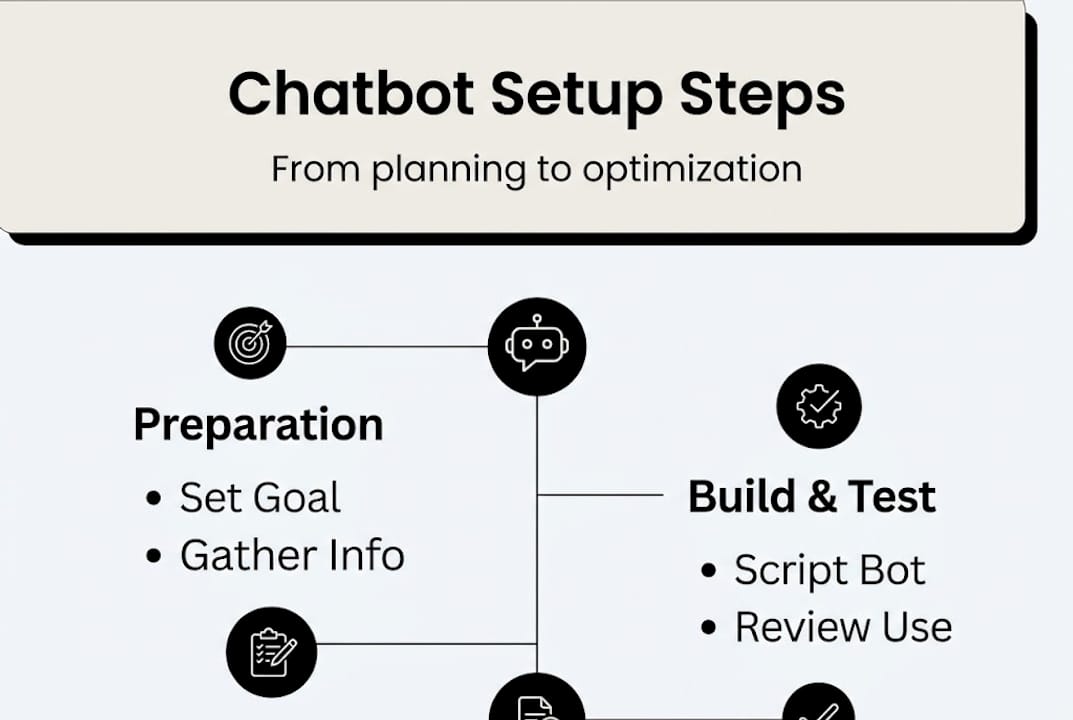
Following a structured approach helps avoid the most common pitfalls in chatbot deployment. Here's the exact process we recommend for home service businesses:
- Define your use cases. Write down the top five questions your customers ask and the top three actions you want the bot to handle. Be specific. "Schedule an HVAC tune-up" is better than "help customers."
- Set up your platform account. Sign up for your chosen platform, connect it to your website or Facebook page, and explore the dashboard before building anything.
- Build your conversation flows. Map out the dialog paths your bot will follow. Start with a welcome message, then branch into options like "Get a quote," "Book a service," or "Ask a question." Keep each path short and direct.
- Integrate with your website or app. Add the chatbot widget to your homepage and service pages. If you use a booking tool like Calendly or ServiceTitan, connect it here.
- Test with your team. Run through every conversation path yourself and with two or three staff members. Look for dead ends, confusing language, or missing options.
- Go live. Publish the bot and monitor it closely for the first 48 hours.
Here's how DIY and consultant-built chatbots compare:
| Factor | DIY build | Consultant-built |
|---|---|---|
| Upfront cost | Low ($0 to $60/month) | Higher ($500 to $3,000+) |
| Time to launch | 1 to 3 days | 1 to 2 weeks |
| Customization | Limited to platform tools | Fully custom |
| Ongoing support | Self-managed | Included or available |
| Best for | Simple lead capture | Complex workflows |
Pro Tip: Write your chatbot scripts the way you talk to customers on the phone. Avoid stiff, corporate language. If your team says "We'll get someone out to you fast," your bot should say the same thing. Authenticity builds trust, even in automated conversations.
With your chatbot built, it's time to ensure it's working the way you want.
Testing, deploying, and optimizing your chatbot
Launching without testing is the fastest way to frustrate your customers. A broken conversation flow or a dead-end response will send leads away, not convert them. Here's how to test and deploy the right way:
- Internal testing: Have every team member run through the bot as if they were a customer. Document every point where the conversation feels awkward or unclear.
- Scenario testing: Simulate your most common customer situations. A new HVAC customer asking about pricing. A repeat landscaping client trying to reschedule. An emergency electrical call after hours.
- Device testing: Check that the bot works correctly on mobile, tablet, and desktop. Most of your traffic is on mobile.
- Soft launch: Share the bot with a small group of real customers or trusted contacts before going fully public. Ask for honest feedback.
- Full launch: Announce the chatbot to your customer base via email or social media. Let your support team know what it handles so they can set expectations.
Regular testing and optimization are crucial for effective chatbot performance over time. Key metrics to monitor include:
- Response completion rate: How many conversations reach a resolution
- Lead capture rate: How many chats result in a contact form submission or booking
- Drop-off points: Where customers abandon the conversation
- Customer satisfaction scores: Use a simple thumbs up or down at the end of each chat
Common mistake to avoid: Don't treat your chatbot as a "set it and forget it" tool. Businesses that launch and never revisit their bot see performance drop within 60 days as customer questions evolve and business details change.
Gather feedback actively. Add a quick rating prompt at the end of each conversation. Review transcripts weekly for the first month. Update your flows based on what you find. A chatbot that improves every month becomes a genuine competitive advantage.
After your bot is live and optimized, what should you expect, and what outside-the-box strategies really work?
Our take: Where most chatbot projects go wrong (and how to succeed)
Here's something most chatbot guides won't tell you: the technology is the easy part. The hard part is understanding what your customers actually need when they land on your website at 9 p.m. with a leaking pipe or a broken furnace.
We've worked with construction, HVAC, landscaping, and electrical business owners who built technically perfect chatbots that still failed. Why? Because they optimized for checkboxes instead of conversations. They asked for too much information upfront. They used industry jargon that confused homeowners. They hid the "talk to a human" option because they wanted to reduce call volume.
The businesses that win with chatbots treat them like a first impression, not a filter. They script conversations with empathy. They make it easy to escalate to a real person. They review transcripts regularly and actually change things based on what they read.
The uncomfortable truth is that a chatbot is only as good as the thinking behind it. Invest more time in your conversation design than your platform selection. Get feedback from real customers, not just your team. And never stop improving it. The businesses we've seen succeed long-term are the ones that treat their chatbot like a living part of their customer experience, not a one-time setup task.
Ready to implement your own chatbot?
Building a chatbot that actually converts takes more than picking a platform and typing a few responses. It takes strategy, smart conversation design, and ongoing attention.
Sharon Jerman specializes in AI strategy and chatbot consulting for home service businesses in construction, landscaping, HVAC, and electrical. From custom chatbot builds to voice AI and full automation strategies, the goal is simple: help you capture more leads and serve your customers better without adding more work to your plate. If you're serious about upgrading your customer experience, book a free consultation and get a clear plan built around your business.
Frequently asked questions
How long does it take to build a chatbot for my home service business?
Most small business chatbots can be created in one to two days using today's platforms, but full testing and optimization may take up to a week before you go live with confidence.
What is the best chatbot platform for home service professionals?
Choosing the right platform means finding one that integrates with your website, offers an easy editor, and includes customer support. Leading options for home service businesses include Tidio, ManyChat, and Chatfuel.
How can I make sure my chatbot doesn't frustrate customers?
Use clear, natural conversation flows and keep menu options to three or four choices at most. Always include an easy path to reach a human so customers never feel trapped.
Do I need technical skills to build a chatbot?
No. Modern platforms enable non-developers to build fully functional chatbots using drag-and-drop editors with no coding experience required.