The Role of AI in Ads Optimization for Marketers
The Role of AI in Ads Optimization for Marketers ! Marketer reviews ad optimization data at desk Most marketing professionals know AI is changing advertising.

Most marketing professionals know AI is changing advertising. Far fewer understand exactly what it's doing inside their campaigns right now. The role of AI in ads optimization goes well beyond automated bidding. It spans creative testing, budget reallocation, audience signals, and micro-decisions happening millions of times per day. If you're still thinking of AI as a simple "set it and forget it" tool, this guide will show you what it's actually doing, what it requires from you, and where human judgment still matters more than any algorithm.
Key Takeaways
| Point | Details |
|---|---|
| AI operates on multiple layers | Bid optimization, creative testing, and budget allocation each add 10–20% performance gains that compound. |
| Data quality determines AI success | Clean, unified, real-time data is the foundation. Inaccurate inputs lead directly to wasted ad spend. |
| Campaign structure matters | Meeting conversion thresholds like Meta's 50 events per week keeps AI out of the learning-limited zone. |
| Human strategy is still required | AI handles tactical micro-adjustments but cannot set brand goals, read culture, or make strategic calls. |
| Time savings are real and significant | AI-driven tools save marketers 12 to 18 hours weekly previously spent on manual bid management. |
How AI in ads optimization actually works
Most people assume AI just automates what a human would do manually, only faster. That's underselling it by a wide margin. AI in advertising operates across three distinct layers, and each one attacks a different inefficiency in your campaigns.
Layer 1: Bid optimization. At the auction level, AI makes millions of micro-decisions per day, adjusting bids based on signals like device type, location, time of day, user history, demographics, and query context. No human team can process that volume. The result is a 15 to 25% improvement in cost per acquisition compared to manual bidding.
Layer 2: Creative testing at scale. Instead of running a standard A/B test and waiting for statistical significance, AI uses multi-armed bandit algorithms to shift traffic toward better-performing variants before you even reach full confidence. Platforms like Meta Dynamic Creative Optimization and Google Responsive Search Ads run thousands of combinations simultaneously, finding audience-specific winners far faster than manual testing ever could.
Layer 3: Cross-platform budget allocation. AI doesn't just optimize within one channel. It reallocates budget in real time across Google, Meta, LinkedIn, and other platforms, responding to live performance data. Static monthly budget splits cannot compete with this.
Here's what makes these layers powerful: they compound. Each layer lifting performance by 10 to 20% doesn't just stack additively. Taken together, multi-layer AI optimization can produce 30 to 50% ROAS improvement over manual campaign management.
Pro Tip: Don't activate all three layers at once if your account is young. Start with bid optimization, get enough conversion data, then layer in creative testing and cross-platform allocation as your account matures.
What your campaigns need before AI can perform
AI is only as smart as the data you feed it. This is where many marketers run into trouble, not because the technology fails, but because the setup around it does.

Clean, unified, real-time data is not optional. It's the prerequisite. When your tracking is broken, your conversion events are mislabeled, or your platforms are siloed, the AI optimizes toward the wrong outcomes. Budget gets misallocated and spend gets wasted, at scale and at speed.
Here are the four setup priorities that determine whether AI optimization works for you:
- Implement server-side tracking. Browser-based tracking alone misses a growing share of conversions due to ad blockers and privacy changes. Server-side tracking and enhanced conversions give AI accurate signal to work with.
- Hit your conversion volume thresholds. Meta recommends approximately 50 optimization events within 7 days per ad set to exit the learning phase. Campaigns that fall short get flagged as "Learning Limited," which means unstable delivery and degraded optimization.
- Consolidate your campaign architecture. Fragmented ad sets with small budgets starve the AI of data. Fewer, larger ad sets with meaningful budget give the algorithm enough room to learn and optimize.
- Define your optimization event carefully. If you're optimizing for a top-of-funnel event like a page view instead of a purchase or lead, AI will optimize toward that event perfectly and deliver zero business value.
Pro Tip: The biggest ROI lifts come from fixing your data architecture, not from tweaking bids manually. Audit your conversion setup before assuming the AI is underperforming.
Where AI falls short and how to work with it
AI is extraordinary at high-frequency, data-driven tactical decisions. It is not good at strategy, brand judgment, or cultural context. Understanding where that line sits is what separates marketers who get results from those who hand over control and wonder why campaigns drift.
- Cold start problem: New campaigns have no historical data. The first few weeks of learning happen at the advertiser's cost. Budget the learning phase accordingly and don't judge performance too early.
- Creative ceiling: AI can test and select among the variants you give it, but it cannot generate the original insight behind a great ad. The quality of inputs you provide caps what AI can achieve.
- The black box problem: AI algorithms may be opaque, making it difficult to understand or justify the decisions being made. You can see the outcome, but the reasoning is often hidden. This is why choosing platforms with transparent reporting matters.
- Volatility without guardrails: AI responds to live data signals, which means it can shift budgets aggressively based on short-term fluctuations. Setting budget caps, bid limits, and performance thresholds keeps it from overreacting.
"A trusted AI platform provides transparent 'glass box' reporting that explains why budget decisions changed, highlighting competitor shifts, audience trends, or market dynamics to build confidence." — Busyocto
The marketer's role has fundamentally shifted. You're no longer the person adjusting bids and testing creatives manually. You're the person setting the strategic direction and ensuring the AI has the right inputs, the right constraints, and the right goals to work toward. That shift requires a different skill set, not less expertise.
Real-world results: what AI-driven campaigns actually deliver
The performance numbers that AI-driven campaigns produce are not theoretical. They show up consistently across industries and account types.
| Optimization Layer | Typical Performance Gain | Key Mechanism |
|---|---|---|
| Bid optimization | 15 to 25% CPA improvement | Per-auction signal processing |
| Creative testing | Faster winner discovery, higher CTR | Multi-armed bandit algorithms |
| Cross-platform budget allocation | 15 to 25% better blended ROAS | Real-time spend reallocation |
| All layers combined | 30 to 50% ROAS improvement | Compounding optimization effect |
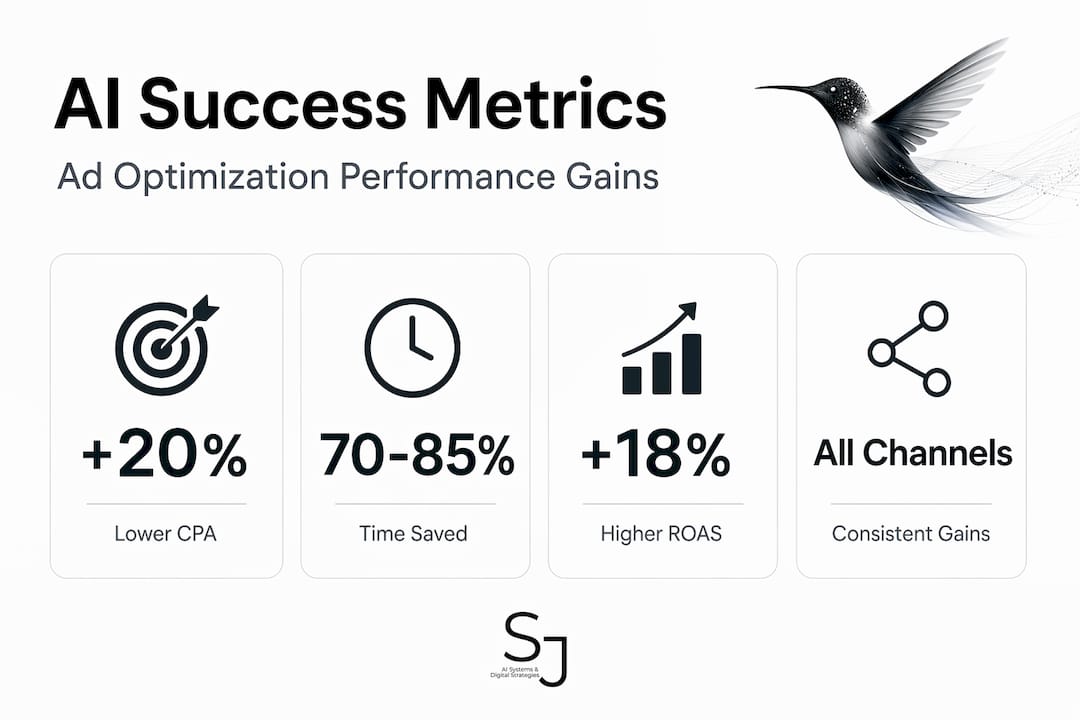
Time efficiency compounds those performance gains. AI-driven optimization tools reduce manual bid management time by 70 to 85%, saving marketing teams 12 to 18 hours every week. That's time that can go directly into creative strategy, offer development, and audience research. For home service businesses managing Meta and Google campaigns, those hours add up to genuine competitive advantage. You can see how this works in practice by reviewing how ad automation boosts efficiency for service-based businesses.
Pro Tip: When evaluating AI performance, compare blended ROAS across all channels, not just platform-reported ROAS. Platform-reported numbers often include attribution overlap that inflates results.
My take on AI as a strategic enabler
I've worked with home service businesses on their Meta and Google campaigns long enough to say this without hesitation: trying to out-calculate AI is a losing game. The volume of signals it processes per auction is not something you can replicate in a spreadsheet.
What I've found actually works is shifting your energy entirely to input quality. The businesses I've seen get the best results from AI in advertising are not the ones tweaking bids constantly. They're the ones with clean tracking, well-structured campaigns, and offers worth optimizing toward.
The uncomfortable truth about AI in advertising is that it can make your mediocre offer more visible, but it cannot make it more compelling. Creative judgment, brand voice, and strategic positioning still live entirely on the human side. I tell every client: give the AI a clean signal and a worthy creative, then let it work. The role AI plays in content creation reinforces this. Better inputs always produce better outputs.
My advice is to treat your AI strategy as a portfolio. Harness it where it excels. Guide it where it needs direction. And stay close enough to the data that you catch drift before it costs you.
— Sharon
Work with Sharonjerman on AI-powered ad campaigns
At Sharonjerman, we help home service businesses get real results from Meta and Google ads by combining AI-driven automation with human strategy. We handle campaign architecture, tracking setup, creative testing workflows, and cross-platform optimization so that your ad budget works as hard as possible. If your campaigns are stuck in the learning phase or your ROAS has plateaued, the issue is almost always structural. We can fix it. Explore AI advertising solutions built specifically for home service businesses and find out what a properly configured AI campaign can do for your growth.
FAQ
What is the role of AI in ads optimization?
AI in ads optimization handles bid adjustments, creative testing, and budget allocation across platforms using machine learning to process signals no human team could manage manually. The result is faster testing cycles, lower CPA, and better ROAS across the board.
How much time does AI save in ad management?
AI-driven tools reduce manual bid management time by 70 to 85%, which translates to roughly 12 to 18 hours saved per week for most marketing teams.
Why is data quality so important for AI ad optimization?
AI optimizes toward the signal it receives. Inaccurate or incomplete conversion data causes the algorithm to misallocate budget, which wastes spend at speed and scale. Clean, real-time data is the foundation of any AI-driven campaign.
What is the learning phase in Meta Ads?
Meta's learning phase is the period when its algorithm gathers data to optimize delivery. Meta recommends 50 optimization events per week per ad set to exit this phase. Campaigns below that threshold are flagged as "Learning Limited" and underperform.
Can AI replace human marketers in advertising?
AI handles tactical, high-frequency decisions exceptionally well, but it cannot replace strategic judgment, brand positioning, or creative thinking. The marketer's role shifts from manual operator to strategic input provider, which still requires significant expertise and oversight.