Voice AI Explained: Boost Your Home Service Business
Voice AI Explained: Boost Your Home Service Business ! Home service owner answering work call Many home service business owners assume voice AI is reserved for Amazon or Google, not plumbers, HVAC technicians, or landscaping companies.

Many home service business owners assume voice AI is reserved for Amazon or Google, not plumbers, HVAC technicians, or landscaping companies. That assumption is costing them real money. Voice AI is already answering phones, booking appointments, and handling after-hours calls for small and mid-sized service businesses right now. This guide breaks down exactly what voice AI is, how it works behind the scenes, and how you can put it to work immediately to capture more leads, reduce staff stress, and deliver faster customer experiences.
Key Takeaways
| Point | Details |
|---|---|
| Voice AI defined | Voice AI enables computers to understand and reply to spoken language with human-like accuracy. |
| Improved customer service | Home service companies use voice AI to provide faster, friendlier service with reduced staff workloads. |
| Real business impact | Voice AI often brings quick ROI through more bookings, fewer missed calls, and 24/7 support. |
| Easy to implement | Modern voice AI platforms are designed for easy integration and quick adoption in service businesses. |
What is voice AI?
Voice AI is software that understands spoken words, figures out what the speaker wants, and responds in a natural, conversational way. It is not a simple voice menu where callers press 1 for billing. It actually interprets the meaning behind words, not just the words themselves.
The engine powering all of this is called natural language processing, or NLP. NLP allows the system to break apart a sentence, recognize intent, and generate a relevant response, even when the caller uses different phrasing each time. Paired with machine learning, the system keeps getting smarter the more it is used. Speech-to-text technology converts what someone says into data the AI can analyze, and text-to-speech converts the response back into spoken audio.
Here is what that means practically for your business:
- A caller says, "I need someone to fix my AC, it's making a weird noise." The AI understands the intent (service request), the category (HVAC), and the urgency.
- The system books the appointment, sends a confirmation, and logs the call into your CRM, all without a human picking up the phone.
- It does this at 2 AM just as reliably as at 9 AM.
Voice AI is not Alexa setting a timer. Modern business-grade voice AI systems handle complex, multi-turn conversations. Businesses using AI for customer interactions report measurable drops in missed calls and significant increases in booked appointments.
One standout statistic: businesses that implement voice AI for inbound calls can reduce average handle time by up to 40%, freeing your team to focus on actual service delivery rather than phone tag.
The biggest misconception is that you need a large IT team to run one. Today's platforms are built for business owners, not developers.
How voice AI works: breaking down the basics
Understanding the steps helps you make smarter decisions when choosing a system. Here is how a voice AI call actually works from start to finish:
- Call capture. A customer dials your number. The voice AI platform answers instantly, with no hold music and no voicemail.
- Speech recognition. The system converts the caller's spoken words into text using speech-to-text technology trained on millions of voice samples.
- Intent detection. NLP analyzes the text to understand what the customer wants, whether that is scheduling, pricing, emergencies, or general questions.
- Data lookup. The AI checks your calendar, job board, or CRM to find available slots or retrieve customer history.
- Response generation. The system generates a natural-sounding spoken response, confirms details with the caller, and takes action such as booking, updating a record, or escalating to a human agent.
- Logging and follow-up. Every call is logged, tagged, and can trigger automated texts or emails to the customer.
Modern voice AI is trained on enormous, diverse voice datasets, which is why it handles regional accents, background noise, and informal language like "y'all" or "gonna" without breaking down. A roofer in Texas and a plumber in New England both get the same accuracy.

The integration piece is where many business owners worry unnecessarily. Most leading platforms connect directly with popular scheduling tools like Jobber, Housecall Pro, and ServiceTitan, as well as Google Calendar and common CRM systems. Setup is often a matter of days, not months.
Pro Tip: Before committing to a voice AI platform, ask vendors specifically whether their system integrates with your current booking tool. Request a live demo using your actual workflow, not a scripted example.
The ability to send automated appointment reminders, collect customer feedback after a job, and re-engage past clients through follow-up calls are all capabilities built into modern systems. You get an always-on communication layer that your competitors likely do not have yet.
Voice AI for home service businesses: key benefits and ROI
Now, let's see what adopting voice AI can actually do for your home service business.
The most direct benefit is capturing revenue you are currently losing. Every missed call from a potential customer is a missed job. After-hours call capture through voice AI means your business effectively never closes. A homeowner searching for an emergency plumber at midnight who gets a live, helpful response from your AI is far more likely to book with you than call a competitor.
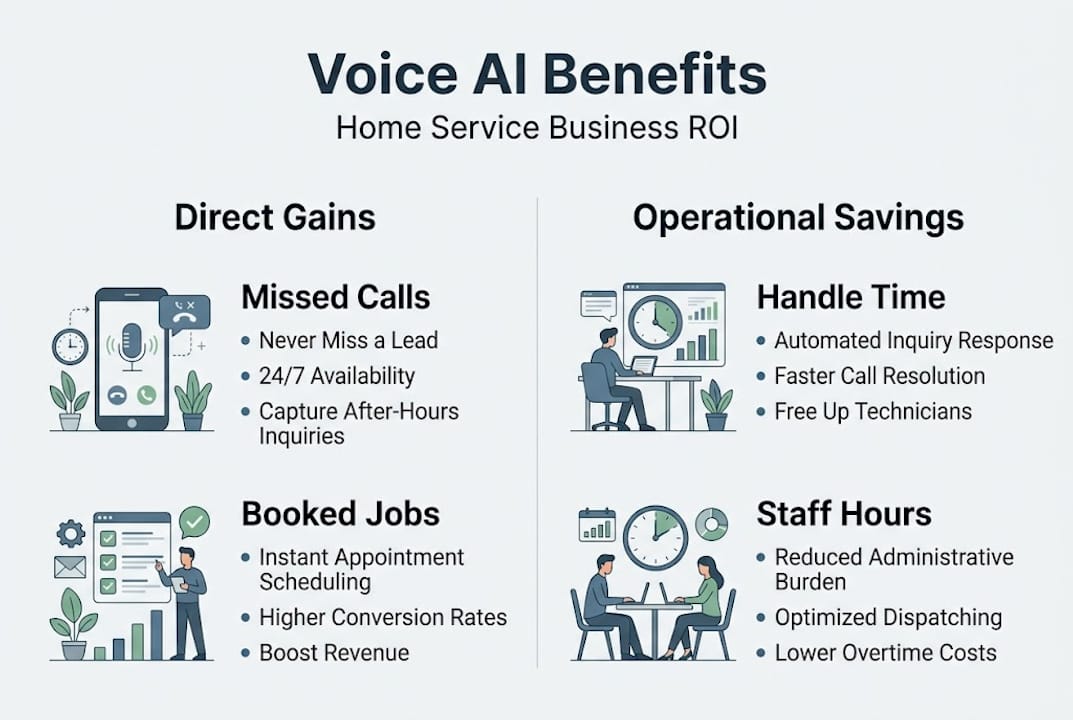
Here is a side-by-side comparison that puts the difference in perspective:
| Scenario | Manual phone response | Voice AI response |
|---|---|---|
| After-hours availability | Voicemail or missed call | Instant answer, 24/7 |
| Average response time | Hours to days | Seconds |
| Appointment booking | Requires staff callback | Booked during the call |
| Call volume capacity | Limited by staff | Unlimited simultaneous calls |
| Customer follow-up | Often inconsistent | Automated and timely |
| Cost per interaction | High (staff time) | Low (software cost) |
Beyond availability, voice AI dramatically improves the customer experience. Faster answers mean higher satisfaction scores. Consistent, polite, on-brand responses build trust. Customers do not have to repeat themselves because the AI logs history.
Key benefits at a glance:
- Reduced no-shows through automated appointment reminders
- Higher booking rates from after-hours and overflow calls
- Lower staff burnout by offloading repetitive call handling
- Faster lead qualification so your team focuses on serious prospects
- Better data from every logged call, giving you insights into peak times and common requests
Pro Tip: To calculate your payback period, estimate the value of one additional booked job per day and multiply by 30 days. Compare that to the monthly platform cost. Most home service businesses reach payback within the first billing cycle.
Choosing and implementing voice AI solutions
Understanding the benefits, let's turn to practical steps for choosing and using voice AI in your business.
Not all voice AI platforms are equal. Your decision should be driven by these factors:
- Compatibility. Does it connect to your existing scheduling and CRM tools?
- Customer data privacy. Is call data stored securely? Does the system comply with relevant regulations?
- Scalability. Can it handle your call volume during seasonal peaks?
- Customization. Can you train it on your specific services, pricing, and brand voice?
- Support. Is there real human support available when something goes wrong?
Here is a quick reference for the features that matter most:
| Feature | Why it matters |
|---|---|
| CRM and calendar integration | Keeps your workflow connected |
| Multi-language support | Serves diverse customer bases |
| Call recording and transcripts | Provides training and compliance records |
| Escalation to live agent | Ensures complex calls get human help |
| Analytics dashboard | Tracks volume, outcomes, and missed calls |
When you are ready to move forward, follow these steps to reduce risk:
- Start with a free trial or pilot program on one service line, such as scheduling calls only.
- Run the AI alongside your existing process for two to four weeks and compare outcomes.
- Train your staff on how the system works and what it handles so they know when to step in.
- Gather customer feedback during the pilot to catch any friction points early.
- Expand to full deployment once the results are clear.
A lighting automation case study from a similar home service context shows how gradual, phased rollouts produce smoother results than going all-in at once.
"AI adoption among small businesses is accelerating, with over 40% of small business owners reporting they use some form of AI in their operations." — U.S. Chamber of Commerce, 2025
The biggest mistake businesses make is expecting the AI to be perfect on day one. Give it time to learn your specific patterns and customer language. The system improves with every call.
What most guides miss about voice AI in service businesses
Most articles focus on features, pricing, and integration checklists. What they skip is the human side of deployment, and that is where most rollouts succeed or fail quietly.
Your staff needs to understand that voice AI is not replacing them. It is handling the repetitive, low-value calls so they can do the skilled work that actually requires a human. Without that framing, resistance builds and adoption stalls. Customer education matters too. Some callers will be skeptical of AI at first. A brief, honest introduction from the AI at the start of each call, like stating it is an automated assistant, builds more trust than pretending otherwise.
The uncomfortable truth is that over-automation is a real risk. If your AI handles every single touchpoint without any human warmth, you start to feel like a call center, not a neighborhood business. The goal is to use AI where speed and consistency matter most, and keep humans where empathy and judgment are required.
Pro Tip: Start your pilot on your highest-volume, most repetitive call type. Scheduling and appointment confirmations are ideal. Save complex service calls and complaints for human handling until you have more confidence in the system.
Explore your voice AI options with Sharon Jerman
If you're ready to explore the possibilities of voice AI for your business, here's your next step. At Sharon Jerman, we work specifically with home service business owners to design, build, and launch voice AI systems that fit how you actually operate. From AI solutions for home services to custom chatbots, content automation, and targeted ad campaigns, our team brings together every tool you need to compete in a fast-moving market. You do not have to figure this out alone. Reach out to discuss your specific workflow and get a clear picture of what voice AI can do for your bottom line.
Frequently asked questions
Can voice AI handle multiple languages and accents?
Yes, modern voice AI systems are trained on diverse datasets and can understand multiple languages and a wide range of accents, making them effective for businesses serving varied communities.
Is voice AI difficult to integrate with existing scheduling systems?
Today's voice AI platforms are designed to connect with common tools and CRMs, making integration straightforward for most home service companies with minimal technical setup required.
How quickly can a small business see ROI from voice AI?
Many small businesses begin to notice efficiency gains and increased bookings within the first few months of active use, especially when the system handles after-hours and overflow calls.
What happens when the voice AI cannot answer a customer's question?
Well-designed voice AI systems include escalation protocols that transfer the caller to a live team member when the request falls outside the system's capabilities, ensuring no customer is left without help.
Do customers respond well to AI-handled calls?
Most customers respond positively when the AI is fast, accurate, and transparent about being automated, and satisfaction rates improve when the system resolves the issue without requiring a callback.