How to Use Voice AI in HVAC to Boost Efficiency
How to Use Voice AI in HVAC to Boost Efficiency ! HVAC technician uses voice AI in van Every missed HVAC call is a missed job.

Every missed HVAC call is a missed job. During peak season, your phones ring nonstop, your techs are already in the field, and after-hours emergencies go straight to voicemail. That's revenue walking out the door. Voice AI changes this by handling inbound calls around the clock, booking appointments, triaging emergencies, and capturing leads without adding headcount. This article walks you through what voice AI is, how to set it up, and how to keep it running smoothly so your HVAC business stops leaving money on the table.
Key Takeaways
| Point | Details |
|---|---|
| Drives efficiency | Voice AI significantly cuts down on manual call handling and reduces missed opportunities. |
| Boosts bookings | Automated agents increase both scheduled appointments and captured leads. |
| Handles emergencies | Properly set up voice AI can triage HVAC emergencies and help dispatch faster. |
| Requires smart setup | Success hinges on HVAC-specific prompts, integration, and ongoing testing. |
| Phased adoption works best | Start with overflow calls, refine the AI, and then scale to all customer interactions. |
What is voice AI for HVAC and why use it?
Voice AI is software that uses natural language processing to conduct real phone conversations with your customers. It listens, responds, collects information, and takes action, all without a human on your end. For HVAC companies, that means customers can call at 2 a.m. about a broken furnace and get real help instead of a voicemail box.
Voice AI agents for HVAC primarily handle inbound customer calls 24/7 for scheduling, emergency triage, support queries, and dispatching. The range of tasks it covers is genuinely impressive:
- Appointment scheduling with real-time availability checks
- Emergency triage to identify urgent calls and escalate immediately
- Lead capture from first-time callers who would otherwise hang up
- Dispatch coordination by integrating directly with your field management tools
- Routine support queries like service area confirmation and pricing tiers
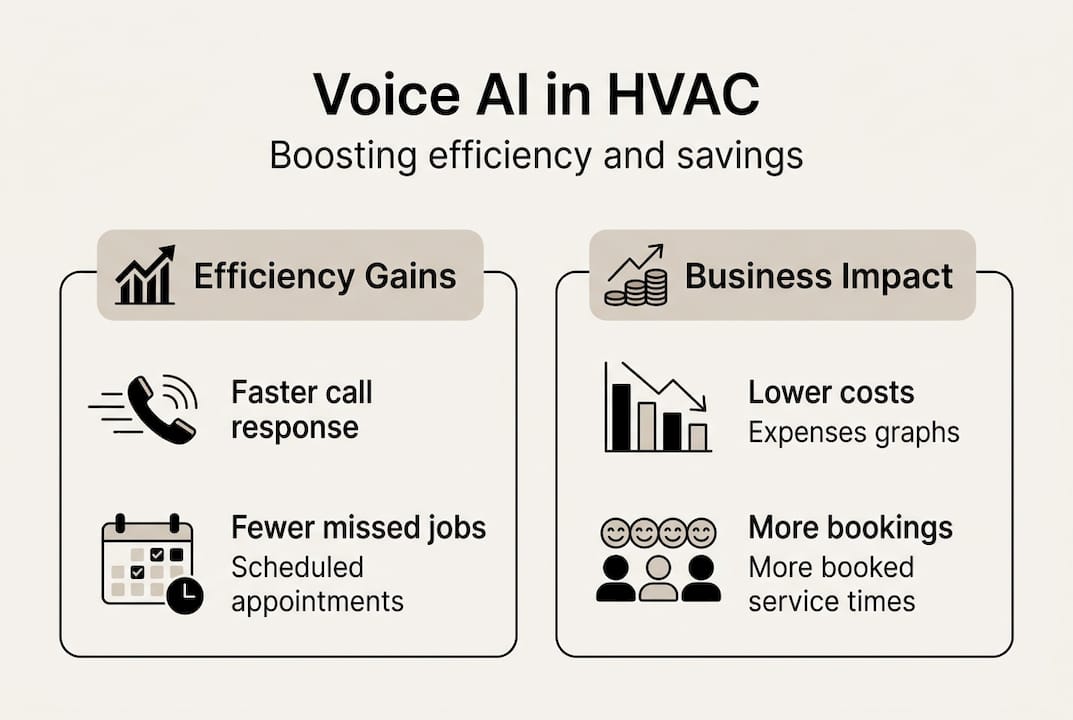
The numbers behind voice AI adoption are hard to ignore. Empirical benchmarks from real HVAC deployments show 60% call deflection and $12K per month in savings, with some operators reporting 81% of leads booked by AI, an 80% drop in abandoned calls, and $300K per year in savings. One platform recorded a 40% increase in bookings worth $14,400 per month, while ServiceTitan AI hits a 70 to 90% booking rate consistently.
| Metric | Result |
|---|---|
| Call deflection rate | 60% |
| Monthly savings (avg.) | $12,000 |
| Leads booked by AI | 81% |
| Drop in abandoned calls | 80% |
| Annual savings potential | $300,000 |
Understanding HVAC efficiency for business makes it clear that operational gaps like missed calls directly cut into your bottom line. Voice AI closes that gap every single night.
What you need: Tools, platforms, and preparation
Before you flip the switch on voice AI, you need the right stack in place. Rushing the setup is the number one reason early deployments fail. Get these pieces lined up first.
Core platforms to evaluate:
| Platform | Role | Best For |
|---|---|---|
| Twilio | Phone number provisioning | Call routing and SMS |
| Vapi | Voice AI assistant engine | HVAC-specific prompt builds |
| Voiceflow | Conversation design | Complex call flows |
| ServiceTitan | CRM and dispatch | End-to-end HVAC operations |
Implementation steps include setting up a Twilio phone number and a Vapi assistant with HVAC-specific prompts, configuring webhooks, integrating with your CRM, and testing emergency scenarios before going live.
Here is what your business data prep checklist should look like:
- Service areas and zip codes your team covers
- Technician availability windows and on-call schedules
- Service type categories (AC repair, furnace install, maintenance)
- Emergency escalation contacts and protocols
- CRM login credentials and API access
One critical point: customized HVAC voice AI consistently outperforms generic call bots because it understands trade-specific vocabulary and customer intent. A generic bot will stumble on terms like "refrigerant leak" or "heat exchanger crack." A properly trained HVAC assistant handles them without hesitation.

Pro Tip: Before writing your AI prompts, record five real customer calls and list the exact phrases your customers use. Build your prompts around their language, not textbook terminology.
Step-by-step: How to implement voice AI in your HVAC business
Here is a practical walkthrough you can follow without needing a developer on staff for every single task.
- Provision your Twilio number. Choose a local or toll-free number, configure it for inbound voice, and connect it to your Vapi account. This is your AI's phone line.
- Build your Vapi assistant with HVAC prompts. Define the call flow: greeting, service type identification, scheduling logic, and emergency detection. Use language your customers actually use.
- Set up webhooks. Webhooks push call data and booking requests to your CRM in real time. Without this, your AI is just taking notes and doing nothing with them.
- Integrate with your CRM and dispatch tool. Connect Vapi to ServiceTitan or your preferred scheduling platform so bookings land directly on your calendar.
- Run scenario testing. Test routine calls, late-night emergencies, confused callers, and callers who speak quickly or have background noise. Fix what breaks.
- Launch in overflow mode first. Let human staff handle primary calls while AI covers overflow. This lets you catch issues without customer impact.
Implementation steps confirm that testing emergency scenarios specifically, before going live, is non-negotiable. A misconfigured emergency flow can delay a response and create real liability.
Pro Tip: Set a maximum call duration limit inside Vapi for non-emergency calls. This prevents the AI from getting stuck in loops with difficult callers and keeps your line available.
Troubleshooting voice AI: Common pitfalls and expert tips
Even a well-built voice AI system will hit friction points in the real world. Knowing what to expect keeps you from panic-fixing at the worst possible time.
Edge cases in HVAC deployments include background equipment noise, incomplete customer data, emergency override failures, and race conditions where two callers book the same slot. A phased rollout is strongly recommended to catch these before they become costly.
Common issues and solutions:
- Background HVAC noise garbling transcription: Adjust your transcriber settings inside Vapi to filter low-frequency noise. Test with recordings from actual job sites.
- Incomplete address data: Build a confirmation loop into your prompt flow that repeats the address back and asks for verification before booking.
- Double bookings from race conditions: Use booking locks in your CRM integration so two simultaneous callers cannot claim the same slot.
- Emergency calls misrouted: Add keyword triggers for phrases like "no heat," "gas smell," and "water leak" that immediately override the standard flow and escalate to your on-call tech.
- AI getting stuck in loops: Set fallback prompts that transfer to a human or voicemail after two failed attempts to gather required information.
"When you are triaging HVAC emergencies through an AI system, the margin for error is smaller than most operators expect. Test your emergency workflows weekly, not just at launch."
Schedule a monthly call audit where you review ten to fifteen recordings. This keeps your prompts sharp and reveals new customer language patterns you may have missed.
The overlooked secret: Why phased rollout and industry expertise matter
Here is what most vendors will not tell you: the technology itself is not the hard part. The hard part is training it to think like an HVAC dispatcher, not a generic customer service rep.
Expert guidance is clear that using trade-specific training over generic AI, setting call time limits, and phasing from overflow to frontline coverage separates the shops that see real ROI from those that give up after a rough first month. Businesses that start with overflow handling first build confidence, collect real call data, and refine their prompts before trusting the AI with every inbound call. That discipline is the actual differentiator. Skip it and you are setting yourself up for frustrated customers and embarrassing failures.
Accelerate your HVAC transformation with expert guidance
Knowing the steps is one thing. Executing them without losing customers in the process is another. The HVAC businesses we see reach breakeven on voice AI fastest are the ones that had experienced help building their call flows, setting up integrations, and running proper tests before going live. If you want to skip the trial-and-error phase and get your HVAC voice AI setup done right the first time, we build and deploy custom voice AI solutions designed specifically for home service businesses like yours. Let's get your phones working for you, not against you.
Frequently asked questions
What are the main benefits of using voice AI in my HVAC business?
Voice AI delivers 60% call deflection, up to $300K per year in savings, and a 40% increase in bookings by automating 24/7 scheduling, lead capture, and customer support. It reduces missed calls and cuts labor costs without sacrificing service quality.
Can voice AI handle HVAC emergencies?
Yes. Properly configured voice AI can triage emergencies and prioritize them over routine scheduling when set up with keyword triggers and escalation workflows. The key is thorough testing before going live.
How do I prevent mistakes like double bookings with voice AI?
Use booking locks inside your CRM integration and test all scenarios to avoid race conditions where two callers attempt to claim the same appointment slot at the same time.
Is voice AI easy for staff to manage day-to-day?
With a phased rollout and user-friendly dashboards in tools like Vapi and ServiceTitan, most HVAC staff can monitor call logs, review bookings, and flag issues without needing technical training.